

Following its first appearance, where Krinwave presented its original kOS operating system and low acoustic power high penetration transcranial ultrasound technology and demonstrated related imaging outcomes, the company introduced its latest exploration progress based on HUS technology (High Penetration Probe, Ultrafast Plane Wave, and Super Resolution Beamforming) at this year’s conference and officially launched the Krinwave kOS Ultrasound Research Open Platform.
The platform enables multi-level openness across the hardware hierarchy, acoustic system hierarchy, multimodal imaging hierarchy, application software hierarchy, and function extension hierarchy. It provides researchers with support for parameter configuration, algorithm construction, model design, and signal analysis within a unified architecture, offering a scalable technical environment for both fundamental and applied ultrasound research.
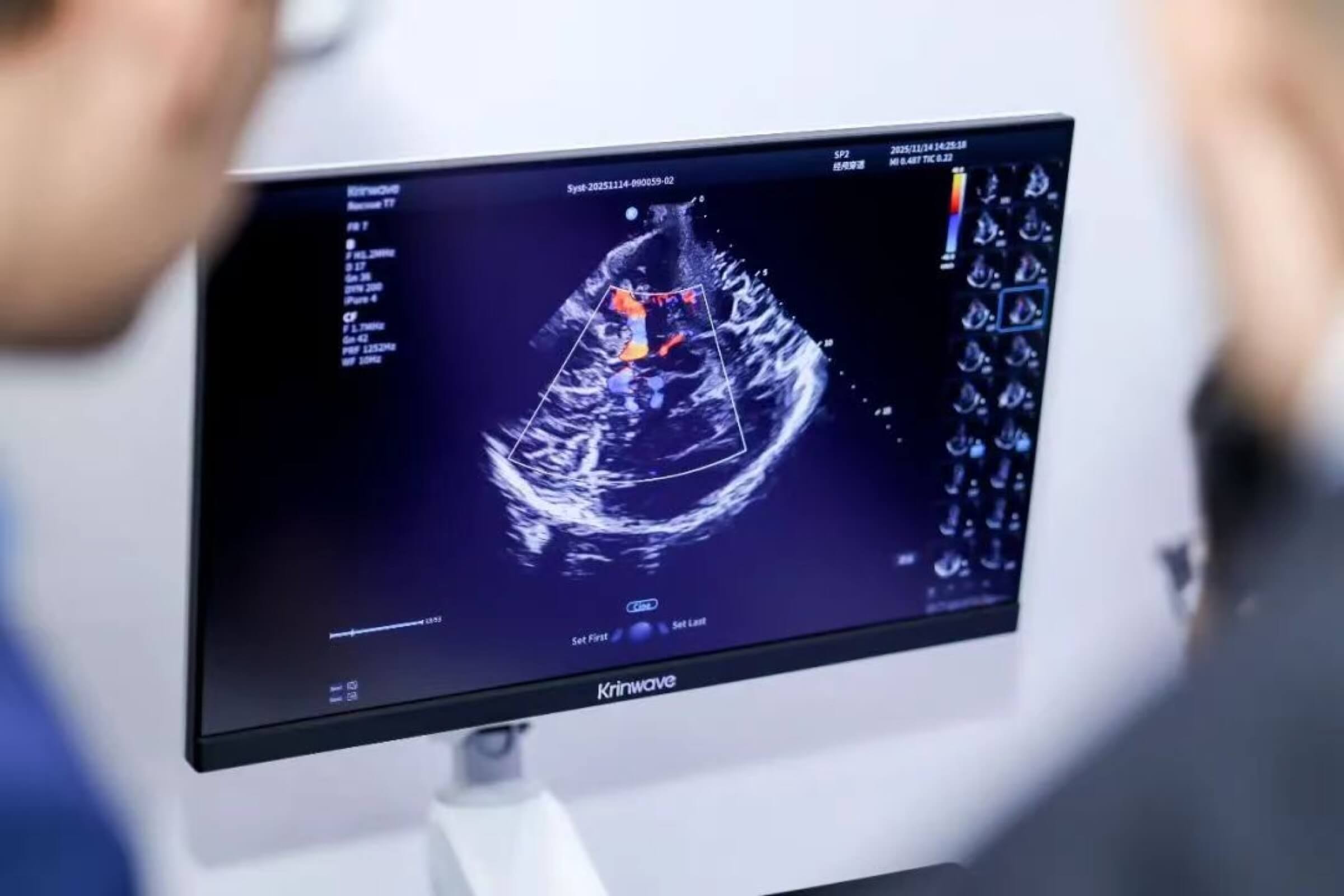
Alongside the platform launch, Krinwave also presented its brain ultrasound innovation solution based on HUS technology. Addressing challenges such as thick cranial bone, strong acoustic attenuation, complex reflections, and low acoustic energy transmission efficiency, the solution has achieved, at the technical parameter level, high penetration (>40 cm), high resolution (approximately 1 mm), and ultrafast imaging (>5000 fps). The on-site presentation covered multiple application scenarios, including bedside assessment of intracranial pressure, cerebral hemodynamics, cerebral edema, and hematoma evolution in neurocritical care; pre-hospital recognition, in-hospital monitoring, and assessment of treatment response in stroke prevention and management; multi-probe adaptation for different age groups in pediatric care; and exploratory imaging research on neurological diseases such as depressive disorders and Alzheimer’s disease in combination with the kOS platform.
Based on the open architecture of kOS and the HUS technology framework, Krinwave has also outlined future directions for technological exploration, including support for multi-model collaborative research in neuroscience and brain functional imaging, as well as the advancement of application-oriented research in areas such as “energy ultrasound (low-intensity focused ultrasound, LIFU)” and “ultrasound brain–computer interface.” These efforts aim to progressively advance brain ultrasound from technological breakthroughs toward more systematic application exploration.